
Judging needs: a quick self-assessment
Judging is the most overlooked part of event planning. You can nail the marketing and logistics, but if the winners feel arbitrary, the event's reputation dies. Consistent, fair evaluation is harder than it looks because it requires more than just knowing the subject matter.
The truth is, consistent, fair, and insightful judging is surprisingly difficult to achieve. It requires more than just subject matter expertise. It demands a structured approach, awareness of bias, and a commitment to evaluating work objectively. You essentially have two main paths forward: building judging capacity within your organization, or outsourcing to professional event judging services.
Deciding between an internal team and a professional service comes down to your staff's bandwidth and how much you value perceived impartiality. If your team is already stretched thin, adding twenty hours of rubric calibration won't end well.
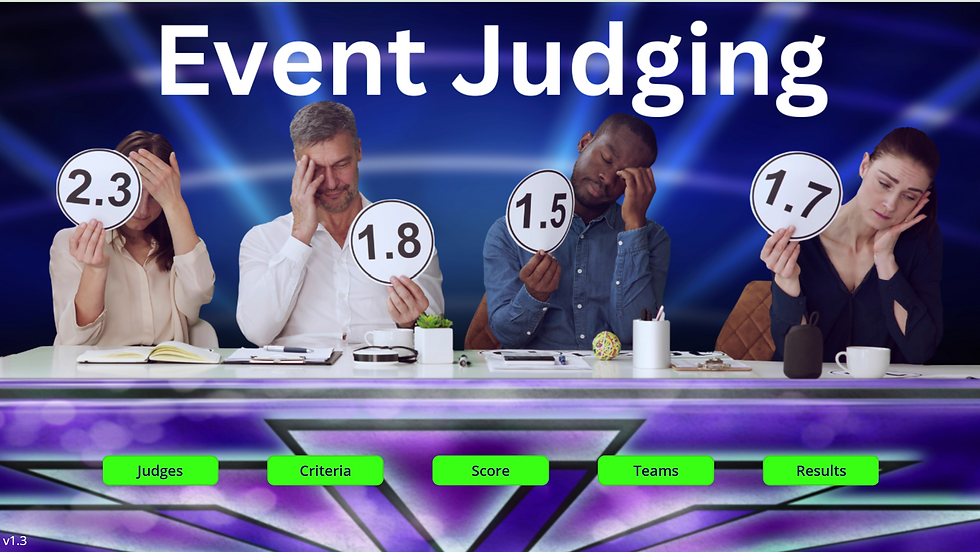
The cost of building an in-house team
Let’s say you decide to build an internal judging team. Where do you begin? First, recruitment. You need to identify individuals who not only possess deep knowledge of the competition’s subject matter, but also demonstrate strong analytical skills and a commitment to fairness. Don't assume someone who is excellent at doing the work will be equally good at evaluating it.
Next comes training, and this is where it gets serious. Effective judging training goes beyond simply sharing the judging criteria. Judges need to understand common cognitive biases – confirmation bias, anchoring bias, the halo effect – and how those biases can creep into their evaluations. They need practice applying the criteria consistently, and they need a clear understanding of the scoring system.
This isn’t a one-time event, either. Building a strong judging team is an ongoing process. Regular refresher courses, calibration exercises, and feedback sessions are essential to maintain consistency and improve performance. It's about developing evaluators, not just assigning tasks. You’re essentially creating a skill set within your organization, which is a significant undertaking.
Training Costs: Beyond the Workshop Fee
It’s easy to underestimate the true cost of in-house judging training. Yes, there’s the immediate expense of a workshop or bringing in a judging consultation expert. But that’s just the tip of the iceberg. Consider the staff time required to attend the training, and the time lost while they’re away from their regular duties.
Then there are the materials – judging guides, scoring rubrics, example evaluations. And don’t forget the ongoing costs of maintaining expertise. Refresher courses, updates to judging criteria as the field evolves, and time spent reviewing and calibrating scores all add up. It's a surprisingly substantial investment.
A bias workshop usually runs about $500 per person. If you pull five senior staff members away from their desks for a full day, you're losing another $1,000 in productivity. Software can help organize the scores, but it doesn't replace the hours spent arguing over rubric definitions.
In-House Training vs. External Judging Services: A Comparison
| Criteria | In-House Training | External Judging Services |
|---|---|---|
| Upfront Cost | Lower initially | Higher initially |
| Ongoing Cost | Potential for medium ongoing costs (materials, trainer time, internal staff time) | Typically predictable, per-event cost |
| Time Commitment | High – significant time investment for training development and execution | Low – minimal time commitment for event organizers |
| Control Over Judges | High – complete control over selection, training, and evaluation process | Medium – control limited to judge selection and communication of scoring criteria |
| Expertise Level | Dependent on internal expertise; can vary significantly | Generally High – judges are experienced and vetted professionals |
| Scalability | Medium – scaling requires additional training resources and internal capacity | High – easily scalable to events of any size |
| Risk of Bias | Higher – potential for existing relationships or internal biases to influence judging | Lower – independent judges minimize potential for bias |
| Event Complexity | Better for simpler events with well-defined criteria | Better for complex events requiring specialized knowledge |
Qualitative comparison based on the article research brief. Confirm current product details in the official docs before making implementation choices.
When you can't compromise on expertise
There are situations where building an in-house judging team simply isn’t feasible. These typically involve competitions requiring highly specialized knowledge or expertise that’s difficult to find and even harder to train. Think about events like scientific poster sessions, where judges need a deep understanding of research methodology and statistical analysis.
Similarly, architectural design competitions demand judges with a strong grasp of design principles, building codes, and sustainability practices. Legal moot court competitions require judges with legal training and experience. In these cases, a generalist judge, no matter how well-intentioned, simply won’t be able to provide a meaningful evaluation.
The risk of inaccurate or biased judging is simply too high. Furthermore, some competitions have legal implications, requiring judges with specific qualifications to ensure fairness and avoid potential liability. When the stakes are this high, specialized expertise is non-negotiable.
Why professional services work
This is where professional judges and judging services come in. The primary benefit is access to a pool of qualified experts with the specific skills and knowledge your competition requires. These services handle the recruitment, vetting, and training of judges, saving you significant time and effort.
They also offer scalability. Need ten judges for a small local event? No problem. Need fifty judges for a national competition? They can deliver. Professional services can adapt to your needs quickly and efficiently. Beyond that, they reduce administrative burden – managing judge schedules, collecting scores, and resolving disputes.
Perhaps most importantly, they bring an element of objectivity. External judges have no vested interest in the outcome of the competition, which can help ensure a fairer and more impartial evaluation. Platforms like Judgify.me streamline the process of connecting event organizers with qualified judges and managing the judging workflow.
How to vet a judging provider
Not all judging services are created equal. Due diligence is crucial. Start by carefully examining the qualifications of the judges they provide. What are their credentials? What experience do they have in your field? What is the vetting process they use to ensure quality?
Next, understand their scoring methodologies. How are scores calculated? How do they ensure consistency across judges? What measures do they take to mitigate bias? Data security is also paramount. How do they protect the confidentiality of submissions and scores? What reporting capabilities do they offer?
Transparency is key. You should have a clear understanding of how judges are selected, trained, and evaluated. Ask about their dispute resolution process. A reputable service will be happy to answer your questions and provide detailed information about their practices.
- Check their vetting process for specific industry credentials.
- Understand the scoring methodology and bias mitigation strategies.
- Assess data security measures.
- Confirm transparency in judge selection and evaluation.
Hybrid Approaches: The Best of Both Worlds?
You don’t necessarily have to choose one approach exclusively. A hybrid model can often be the most effective. For example, you might train a core team of internal judges to handle the preliminary rounds of a competition, and then bring in external experts for the finals.
This allows you to leverage your internal expertise while benefiting from the specialized knowledge of external judges. Another option is to use external consultants to develop your judging criteria and train your internal team. This ensures that your judging process is aligned with best practices and that your judges are well-equipped to evaluate submissions fairly.
The key is to identify your strengths and weaknesses and then tailor your approach accordingly. Perhaps your team excels at initial screening, but needs external validation for final decisions. A hybrid approach offers flexibility and allows you to optimize your judging process for maximum impact.
Sharpen Your Judging Skills: Essential Reads for Fairer Evaluations

Explores the two systems that drive the way we think · Explains how we can tap into better thinking to make smarter choices · Reveals common cognitive biases that affect judgment
This book offers invaluable insights into cognitive biases and decision-making, helping judges and organizers understand how to conduct fairer and more effective evaluations.

Examines the irrationality that governs our decision-making · Reveals the hidden forces that shape our choices · Uses experiments to demonstrate why we make the decisions we do
This book offers invaluable insights into cognitive biases and decision-making, helping judges and organizers understand how to conduct fairer and more effective evaluations.

Explains how 'choice architecture' can influence decisions · Provides practical strategies for improving decision-making in various aspects of life · Focuses on how small changes can lead to significant improvements
This book offers invaluable insights into cognitive biases and decision-making, helping judges and organizers understand how to conduct fairer and more effective evaluations.

Details 99 common thinking errors · Offers practical advice to avoid mistakes and make better decisions · Presents research-backed insights into faulty reasoning
This book offers invaluable insights into cognitive biases and decision-making, helping judges and organizers understand how to conduct fairer and more effective evaluations.
As an Amazon Associate I earn from qualifying purchases. Prices may vary.

No comments yet. Be the first to share your thoughts!